


Most shops know their machine table. Most shops know their fixtures. The piece between them gets less attention, and that is usually where setup time and repeatability problems start.
The CNC sub plate is a precision-ground flat plate that mounts directly to the machine table and creates a stable, reusable interface for all the workholding above it. Instead of bolting vises, tombstones, and angle plates directly to T-slots at a fixed pitch, you fasten everything to the sub plate. The sub plate handles the connection to the table. Your fixtures handle the connection to the part. And when the job changes, you move the fixture, not the table geometry.
If your shop is re-indicating the same fixture every time a job runs, or drilling into the machine table every time a new setup needs a different hole location, a sub plate is the direct fix to both.
What Is a CNC Sub Plate?
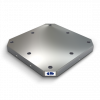
A CNC sub plate (also called a fixture plate or tooling plate) is a flat, precision-ground plate that bolts to the machine table and serves as the mounting surface for workholding fixtures. The plate sits between the table and whatever is clamping your part: a vise, a tombstone, an angle plate, a zero-point receiver, or a custom fixture base.
The critical specification is flatness. A quality cast iron sub plate holds flatness to within 0.0005″ to 0.001″ across the full face. That ground surface transfers directly to any fixture mounted on top of it, which is what makes sub plates useful for precision work. You are not just adding a layer of metal between the fixture and the table. You are adding a precision datum that every setup above it references.
Sub plates come in three surface configurations, each suited to different setup requirements:
- Plain surface. A ground top face with no pre-drilled features. Shops drill and tap their own hole pattern to match specific fixture bases. Best when a custom layout is needed or when a job runs for a long time without changing.
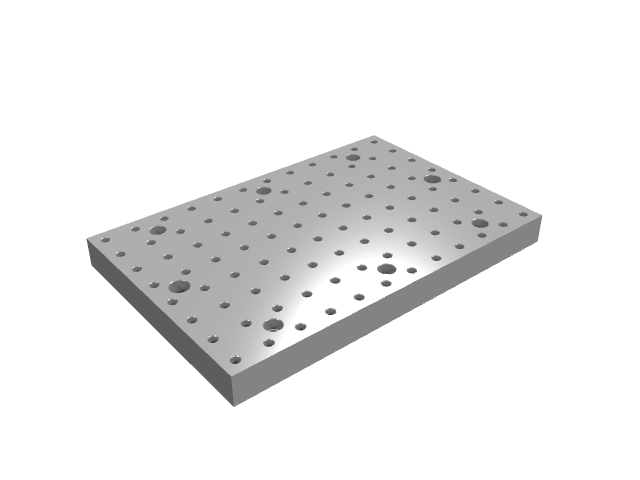
- Grid pattern. A regular array of precision holes at consistent pitch (typically 1″ or 25 mm) across the full surface. Compatible with modular tooling systems and lets you move fixtures anywhere on the plate without cutting new holes.
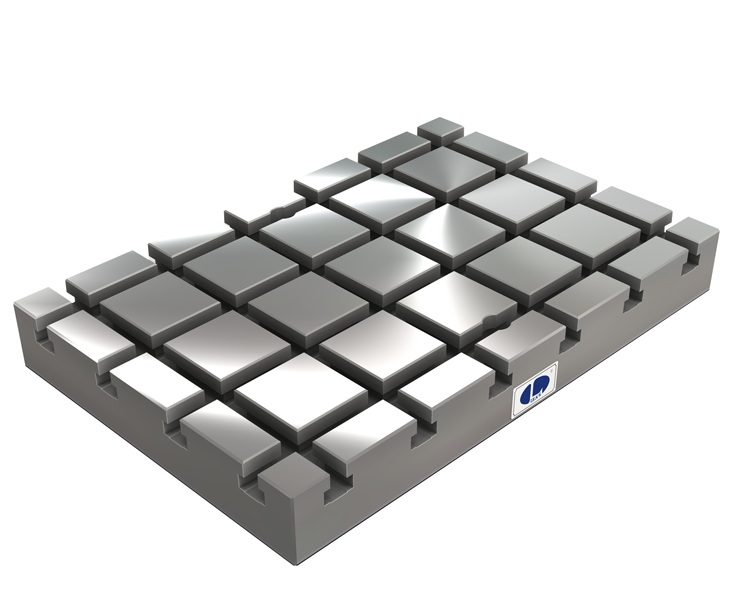
- T-slot pattern. T-slots machined across the surface for traditional T-bolt and T-nut clamping. Works like a scaled-down machine table mounted above the actual table, and is compatible with large existing inventories of T-bolt fixturing hardware.
Where the Sub Plate Fits in Your Workholding Stack
The machine table has T-slots at fixed pitches. That works for bolting things down, but it does not give you a modular or repeatable interface from job to job. The sub plate translates the table’s fixed geometry into whatever hole pattern or slot layout your fixtures need.
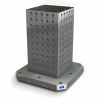
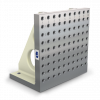
In a typical horizontal machining center setup, the stack looks like this: the pallet comes out, the sub plate is bolted to the pallet face, and then the CNC tombstone or angle plate mounts to the sub plate. When the pallet swaps, the sub plate and everything on top of it move with it as a unit. The datum does not change. The operator does not re-indicate. The part is in the same position it was in on the last cycle.
The sub plate also protects the machine table. Drilling and tapping directly into a precision table adds wear, corrosion risk, and potential for damage from fixture hardware. A sub plate takes that wear instead. When the surface is worn or you need a different hole layout, you replace the sub plate, not the table.
Sub Plate Surface Configurations in Detail
Choosing the right surface pattern is a function of what you are mounting and how often the setup changes.
Grid sub plates are the most flexible option for shops running modular tooling. The precision hole grid provides a consistent locating reference across the full plate. You can position a vise, a zero-point receiver, or a custom base anywhere on the grid, fasten it down, and relocate it later without cutting new holes. The BP02 Rectangular Grid Sub Plate is available in a range of sizes from compact VMC setups to full HMC pallet configurations. The hole pitch is consistent across the full surface for modular compatibility.
T-slot sub plates suit shops with established T-bolt fixturing inventories. The T-slots accept standard T-nuts and T-bolts the same way a machine table does, so existing fixtures go on without modification. The BP03 Rectangular T-Slot Sub Plate brings that interface in a removable, repeatable plate that sits above the actual table rather than substituting for it.
Plain sub plates work best when a specific fixture base requires a non-standard hole layout, or when a long-running job justifies drilling a dedicated pattern. Once the pattern is in, it stays. Plain plates are also the starting point for shops that want to machine their own features into the top surface.
When Does a Shop Actually Need a Sub Plate?
A sub plate makes sense in several specific situations, and most shops running mid- to high-mix production will recognize at least one of them.
You re-indicate the same fixture every time it goes on the machine. If a job comes back and you spend 15 to 30 minutes indicating the fixture into position, you have no repeatable datum. A sub plate with precision dowel pins or a zero-point receiver brings that re-indicate time to near zero. Modern Machine Shop has documented shops eliminating hours of setup time per week after moving to standardized fixture plate systems.
You are running tombstones or angle plates on a pallet machine. Sub plates are standard practice on HMCs with pallet changers. The sub plate mounts to the pallet once, and the tombstone or angle plate mounts to the sub plate. When the pallet swaps, the entire stack moves as a unit with the datum intact. When shops pair sub plates with zero-point mounting, the results are measurable: Modern Machine Shop coverage of Lyndex-Nikken’s zero-point system documented 0.0001″ repeatable location and changeover time reductions of up to 90%.
You are building a new fixture for every job on the same machine. If each new job means drilling into the table or building a fixture from scratch, you are paying for that setup engineering time repeatedly. A grid or T-slot sub plate gives you a universal interface so new fixtures bolt to known hole locations in a consistent orientation.
You want to protect the machine table. Every bolt hole drilled into a precision table is a potential location for wear and damage. A sub plate takes that wear. When the face is worn or the layout needs to change, the sub plate comes off and a fresh one goes on. The table stays clean.
Sub Plate Material: Cast Iron vs. Aluminum
Most CNC sub plates are cast iron, and for most shops, that is the right call. Cast iron offers better vibration damping in heavy cutting operations, which reduces chatter transmission from the fixture to the part. It is also more thermally stable than aluminum, so the flatness spec holds across shop temperature variation better than an aluminum plate would.
Aluminum sub plates are lighter, which matters when the plate is large and the operator is handling it manually on a frequent pallet changeover. For shops using aluminum machine tables (common on some VMC builders), aluminum sub plates also match the thermal expansion coefficient of the table, which keeps the interface stable under temperature swings. Production Machining notes that thermal stability in the fixturing stack is one of the underappreciated contributors to dimensional consistency in high-volume production.
For steel, titanium, and aluminum aerospace work on a cast iron or steel machine, cast iron sub plates are the standard choice.
Key Takeaways
The sub plate is not a complicated piece of hardware. It is a flat, precision plate that creates a consistent interface between your machine table and everything above it. What makes it valuable is repeatability: every fixture that mounts to a sub plate references the same ground datum, job after job, pallet swap after pallet swap. That consistency is what reduces re-indicate time, protects the machine table, and makes modular fixture systems practical instead of aspirational.
If your shop is losing setup time to re-indication, wearing out the machine table with direct fixture hardware, or building new fixture layouts from scratch every time a job changes, a sub plate is the direct fix.
Ready to Build a More Repeatable Workholding Setup?
Tombstone City stocks precision cast iron sub plates in rectangular, square, and round profiles, available with plain surfaces, grid hole patterns, and T-slot configurations. Sizes range from compact VMC setups to full HMC pallet dimensions. Browse the full sub plate lineup or call our team at 631-385-9452 to talk through the right plate size, pattern, and material for your machine, your fixtures, and your production volume.