



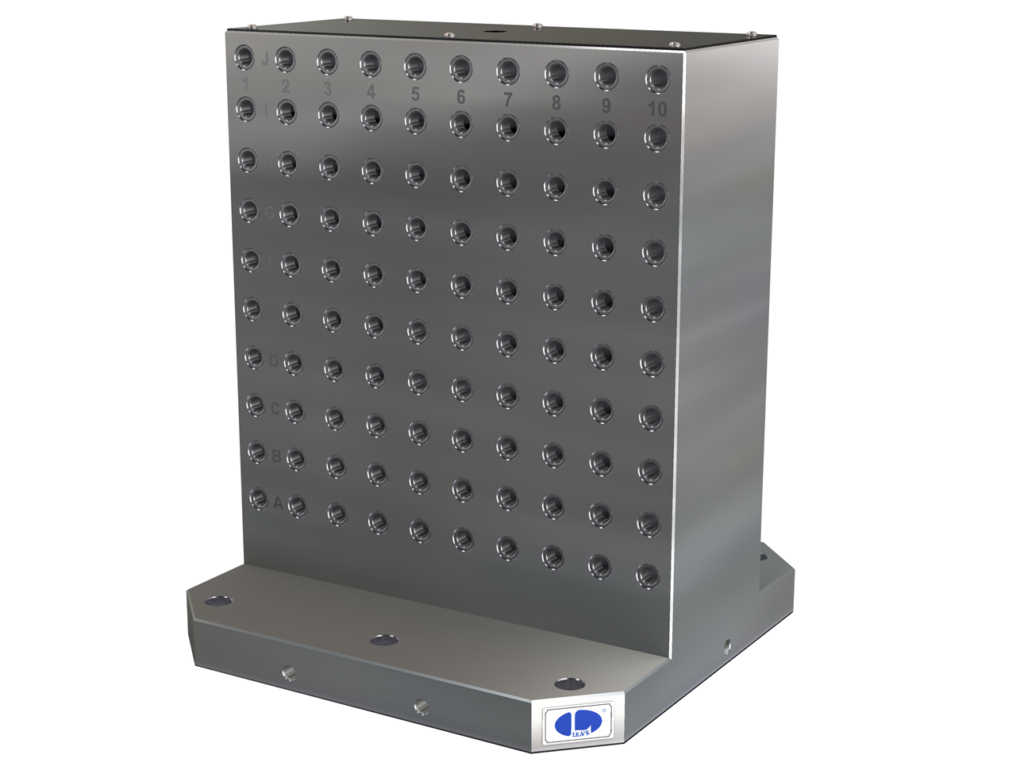
Most tombstone sizing mistakes don’t show up on the receiving dock. They show up the first time the B-axis indexes with a full load and a vise jaw clips the way cover, or when the top row of parts sits above the highest point the spindle can reach, or when the pallet changer faults because the loaded pallet is over its weight rating.
This CNC tombstone sizing guide covers the five checks we run with customers before they buy: base-to-pallet fit, B-axis swing, height and spindle reach, weight, and whether a standard size will do the job. Keep your machine’s spec sheet and pallet drawing open while you read. Every number that matters comes from those two documents.
Matching the Tombstone Base to Your HMC Pallet Size
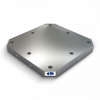
Most HMC pallets are square and come in a short list of nominal sizes: 300 mm, 400 mm, 500 mm, 630 mm, and 800 mm, with 1,000 mm and larger on big-iron machines. The HMC pallet tombstone size starts here, because the base is built to the same nominal footprint as the pallet. On our CNC tombstones, the part number calls out the base. A BP08-500500 is a 500 x 500 mm base built for a 500 mm pallet.
Matching the nominal size is only half the job. The tombstone base pattern has to line up with every locating feature on your pallet:
- Mounting holes or T-slots: Bolt spacing and thread size have to match the pallet drawing. Tapped-hole grids are commonly M12, M16, or M20 depending on pallet size.
- Center bore: The bore diameter and fit put the tombstone on the B-axis centerline.
- Locating key or dowels: A key slot, two dowel holes, or an edge locator sets angular orientation, so every face starts square to the X axis.
- Clipped corners: A full-square 400 mm plate has a 566 mm diagonal, which is larger than many 400 mm machines allow for swing. That is why tombstone bases have chamfered or clipped corners.
Many builders follow the ISO 8526 pallet layout, but plenty use their own pattern. If the base doesn’t match your pallet, an adapter sub plate bridges the two. A sub plate adds height and weight, and both feed directly into the checks below.

Calculating B-Axis Swing Clearance
Every HMC publishes a maximum swing or maximum part diameter. That number is the cylinder your loaded pallet has to fit inside during a full 360-degree index. Haas, for example, lists a 22 in (559 mm) maximum part diameter for its EC-400 pallet pool.
For the bare tombstone body, the swing diameter is the corner-to-corner diagonal: Swing Ø = √(L² + W²). A 300 x 300 mm body sweeps a 424 mm circle. That looks like plenty of room on a 559 mm machine, but it isn’t the number that will crash you.
For the loaded tombstone, measure to the outermost point on each face: Swing Ø = 2 × √((T/2 + P)² + S²), where T is the face-to-face thickness, P is the projection from the face to the outermost point, and S is the sideways distance from the centerline to that same point. Put a vise projecting 100 mm on that 300 mm body, with its outer corner 80 mm off center, and you get 525 mm. That fits. Add a raw blank standing 20 mm above the jaws and you get 563 mm, which is 4 mm over the limit. The vise was never the problem.
Shop rules for B-axis rotation clearance:
- Size to raw stock: Blanks are always bigger than finished parts.
- Check every face: The largest result sets the swing for the whole tombstone.
- Count the extras: Clamp handles, hydraulic fittings, coolant lines, and probe targets all sweep the same circle.
- Keep margin: Hold at least 25 mm on diameter for chips and stock variation.
- Read the interference diagram: Way covers, chip guards, and the pallet changer door can reduce swing at certain heights.
CAM simulation catches what hand math misses. Autodesk notes that FeatureCAM uses the tombstone dimensions you enter to simulate toolpaths and calculate retract distances, so accurate tombstone geometry in CAM is a sizing tool, not just a programming step.
Tombstone Height, Spindle Reach, and the Y/Z Work Envelope
Tombstone height clearance is a balance. Too short, and you waste Y travel and lose a row of parts on every face. Too tall, and the top row sits above the spindle’s reach or the tombstone exceeds the machine’s maximum part height.
The Y axis sets your usable face band. It runs from the lowest spindle centerline height above the pallet top to that height plus Y travel. With a 70 mm minimum centerline and 635 mm of Y travel, feature centers above 705 mm are out of reach, and a 750 mm tombstone carries 45 mm of dead face at the top. At the bottom, base plate thickness and vise jaw height lift your lowest row, so check it against the minimum centerline too.
The Z axis sets index retract. Before the B-axis turns, the longest tool in the program has to clear the swing radius: spindle nose to pallet center at full Z retract, minus the longest tool gauge length, must be greater than the swing radius plus margin. With 600 mm of retract and a 250 mm tool, you have 350 mm against a 282 mm swing radius. Swap in a 330 mm boring bar and you are down to 270 mm. That index will crash unless the program changes tools or moves in X first. For install and probing, see our Tombstone City HMC setup guide.
Weight Capacity and Acceleration Limits
The pallet rating covers everything on the pallet: sub plate, tombstone, vises and fixtures, raw stock, and the chips and coolant that pile up during a run. Ratings vary more than people expect, even on the same machine. Haas lists a 500 lb (227 kg) maximum pallet load for the EC-400 pallet pool, so a tombstone package that runs fine on a twin-pallet machine can be overweight in a pool cell. Aluminum weighs about one third as much as steel, which matters when you are close to the limit.
Static weight is only part of the load on a full 4-side setup:
- Rotational inertia: It grows with the square of the radius, so mass at the outer edge of a fixture is much harder on the B-axis drive and clamp than the same mass near center.
- Unbalanced loads: Loading only adjacent faces puts an offset moment on the rotary table every index. Load opposite faces as pairs.
- High center of gravity: A tall, top-heavy tombstone loads the pallet clamping hard during rapid moves and pallet changes.
- Builder limits: Many builders publish an allowable unbalance or inertia limit, and some require reduced B-axis acceleration settings for heavy loads.
Our rule of thumb is to plan the fully loaded pallet at no more than 80 to 85 percent of the rated capacity.
Standard Tombstone Dimensions vs. a Custom Tombstone Size
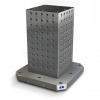
Standard tombstone dimensions cover most jobs. Our catalog includes square plain, square grid, square T-slot, and T-style tombstones in base sizes from 300 mm through 1,000 mm, with multiple heights per base. Stay standard when your pallet uses a standard pattern, your loaded swing fits with margin, and your workholding is modular, such as modular vises on grid or T-slot faces.
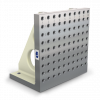
A custom tombstone size makes sense when the pallet has a non-standard pattern, when swing is tight enough to need a narrower body or deeper corner clips, or when you need a window tombstone for back-side access, angled faces, an odd number of faces, or integrated hydraulics. For compound angles, angle plates on a standard face can sometimes do the job without going custom. When they can’t, send your pallet drawing, machine model, and part envelope through our custom fixture request, and we will build the geometry around your actual HMC work envelope planning numbers.
Key Takeaways
A tombstone has to fit three envelopes at once: the pallet footprint, the B-axis swing diameter, and the reachable Y/Z work zone, all inside the pallet’s weight rating. The bare tombstone almost never causes the crash. The vise, the raw blank, and the longest tool do.
Match the base pattern, not just the size. Calculate swing with raw stock loaded. Check every row against Y travel and every index against Z retract. Plan weight at 80 to 85 percent of rating. Go standard when the numbers fit with margin.
Free CAD Files for Every Tombstone City Tombstone
Verify the fit in CAM before you buy. Every Tombstone City tombstone has a free STEP model you can drop onto your machine model, load with your fixtures and raw stock, and index through a full 360 degrees in simulation. Not sure which size fits your pallet? Try our Find Your Tombstone tool, or call 631-385-9452 or email info@tombstonecity.com. Browse and download at the Tombstone City CAD Library.