



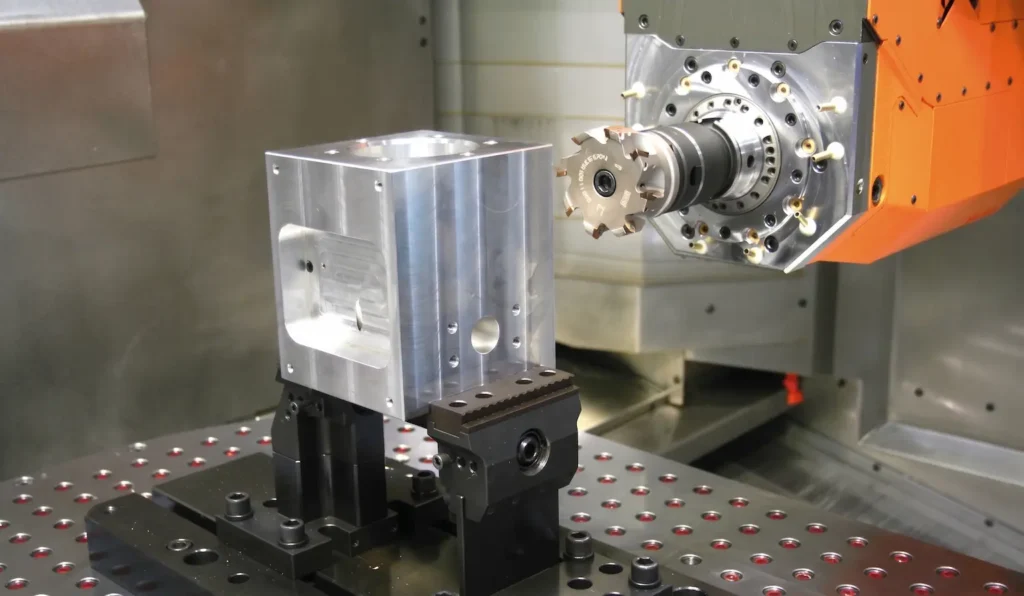
Aerospace parts punish weak workholding. A bracket that is thin, pocketed, and made from 7075 aluminum or titanium can pass every in-process check and still fail inspection because it moved the moment the clamps came off. Add tight tolerances, expensive material, and first article inspection on every new part number, and the fixture becomes as important as the machine.
There is no single best fixture for every aerospace job. This guide covers the CNC workholding for aerospace parts that shops rely on most, what each one is good at, and how to match it to the part in front of you.
What Makes Aerospace Workholding Different
Most of the rules are the same as any precision job. The margin for error is smaller.
- Hard-to-machine materials: Titanium and nickel alloys such as Inconel push high cutting forces into the part and the fixture. Rigidity and damping matter more than in aluminum work.
- Thin walls and deep pockets: Structural parts are often machined from solid billet, with most of the stock removed. What is left is light, flexible, and easy to distort.
- Expensive stock: A scrapped titanium forging costs far more than a scrapped aluminum block. Getting the first part right is worth extra setup time.
- Process control: Shops working to AS9100 and AS9102 first article requirements need setups they can document and repeat exactly, not ones that depend on who ran them last.
5-Axis Vises for Complex Aerospace Parts
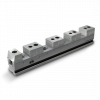
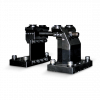
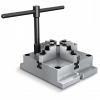
A raised 5-axis vise is often the starting point for brackets, fittings, and housings with features on five sides. Lifting the part above the table gives the tool access to every side in one setup, so you can use shorter tools and fewer re-clamps. Every re-clamp you remove is one less chance to lose a datum between operations.
Grip only what you need. Hold the part on a small amount of extra stock at the bottom and machine everything above it. On aerospace work, that sacrificial stock is cheap insurance: it carries the clamping load, and it comes off in the last operation.
Keep it stiff. The higher the part sits, the more the cutting forces can push it around. Raise it only as far as tool access requires, and choose jaws that match the material and the force of the cut. Our 5-axis vises mount to 40 mm, 50 mm, and 2 in grid patterns and to T-slot base plates, so the same vise moves between machines.
Tombstones and HMCs for Aerospace Production
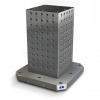
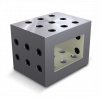
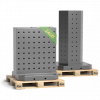
When an aerospace part moves from prototype to production, the horizontal machining center earns its place. Chips fall away from the part instead of packing into pockets, and a loaded tombstone runs several parts or operations per pallet change.
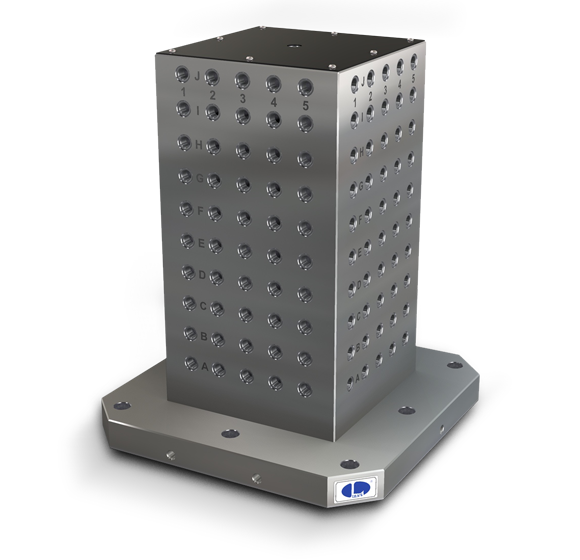
- Split operations across faces: Put Op 1 on two faces and Op 2 on the other two, so a finished part comes off with every cycle.
- Balance the load: Heavy titanium blanks on only one side of a tombstone load the B-axis unevenly. Load opposite faces as pairs.
- Mount fixtures modularly: Modular vises on grid or T-slot faces let you change part families without building a new dedicated fixture each time.
If you are setting up a tombstone for the first time, our Tombstone City HMC setup guide walks through mounting, indicating, and the first dry cycle.
Holding Thin-Walled and Distortion-Prone Parts
Thin-wall work is where aerospace fixturing gets hardest. Two problems drive most of the scrap: clamping force bends the part, and residual stress in the stock releases as material comes off.
Separate roughing from finishing. Rough the part with generous stock left, unclamp it so it can relax, then reclamp with lighter force for finishing. A part that is going to move should move before the final cuts, not after.
Clamp where the part is strongest. Hold on thick sections, bosses, or extra stock, never on a thin wall. If you must support a wall, use support that pushes back lightly instead of a clamp that pulls it into position.
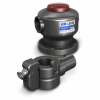
Consider low-force methods. Vacuum fixtures suit flat skins and panels. Adhesive workholding is another option. Modern Machine Shop profiled a shop that bonds thin parts to grippers so they are held in their free, undistorted state, avoiding the spring-back that mechanical clamps cause.
Account for residual stress. Stock that has been heat-treated carries stress that comes out during machining. Research from Fraunhofer IPT, reported by American Machinist, cut distortion by 94% on a titanium aerospace structural part by combining distortion simulation with adaptive clamping that released stress during machining. Most shops won’t run that setup, but the lesson is the same: plan the machining sequence and the clamping together.
Building Repeatable Setups for Aerospace Quality
Aerospace customers expect the hundredth part to match the first article. That depends as much on the fixture as on the program.
- Locate on a grid: Grid sub plates and tombstone faces put every fixture at a known position, so work offsets carry from one run to the next.
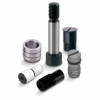
- Dowel the fixture: Two dowels between the fixture and the plate let it drop back into the same location without re-indicating. Our accessories include the dowel pins and positioning bushings to do this.
- Identify and document everything: Give each fixture an ID and record its location, clamp torque, and offsets with the job. That record supports first article inspection and makes the setup the same no matter who runs it.
- Verify in CAM first: Model the fixture, stock, and clamps before cutting, so collisions and reach problems show up on screen instead of on a titanium forging.
Matching the Workholding to the Aerospace Part
- Multi-sided brackets and fittings: A 5-axis vise, gripping extra stock that is cut off in the last operation.
- Housings and manifolds in volume: A tombstone on an HMC with modular vises, Op 1 and Op 2 on the same pallet.
- Thin skins and panels: Vacuum or adhesive fixtures that hold the part without bending it.
- Large or unusual parts: A dedicated fixture built around the part’s datums. Send the part model through our custom fixture request, and we will design around it.
Key Takeaways
The best CNC workholding for an aerospace part is the setup that holds it rigidly without distorting it, gives the tool full access, and repeats exactly from the first article to the last part. For most shops, that means 5-axis vises for complex single parts, tombstones on HMCs for production, and low-force methods for thin walls, all located on a doweled grid.
Grip on extra stock. Rough, release, then finish. Clamp where the part is strongest. Balance the tombstone. Document every setup.
Free CAD Files for Aerospace Fixture Planning
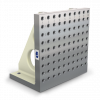
Prove the setup in CAM before you cut expensive stock. Every Tombstone City tombstone, angle plate, and vise has a free STEP model you can drop into your machine model with your part and clamps to check reach and clearance. Need help choosing a setup for an aerospace job? Call 631-385-9452 or email info@tombstonecity.com. Browse and download at the Tombstone City CAD Library.