
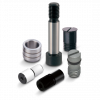

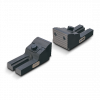
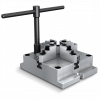
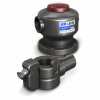





If you’re still running standard vises on your HMC or VMC, you’re likely leaving machine capacity on the table every cycle. The question isn’t whether a modular vise system outperforms a standard vise, it does, and the numbers aren’t close. The real question is: how much productivity are you giving up, and does the switch make sense for your parts and your production volume?
This breakdown covers exactly that. We’ll look at how each system works, where each one makes sense, and what the actual throughput difference looks like when you run the math on a real pallet cycle.
What Is a Standard Vise?
A standard machine vise is a single-station clamping device with a fixed jaw and a moveable jaw driven by a leadscrew. It’s been the default workholding solution in machine shops for decades, and for good reason. It’s simple to set up, widely understood, and reliable for one-off and short-run work.
The limitation is capacity. A standard vise holds one part per station, two stations per rail at best. Every time that part is finished, the operator opens the vise, loads the next part, re-clamps, re-zeros if needed, and starts the next cycle. That’s operator time, that’s spindle-down time, and on an HMC where pallet cycling is supposed to happen unattended, it’s a bottleneck built into the fixture itself.
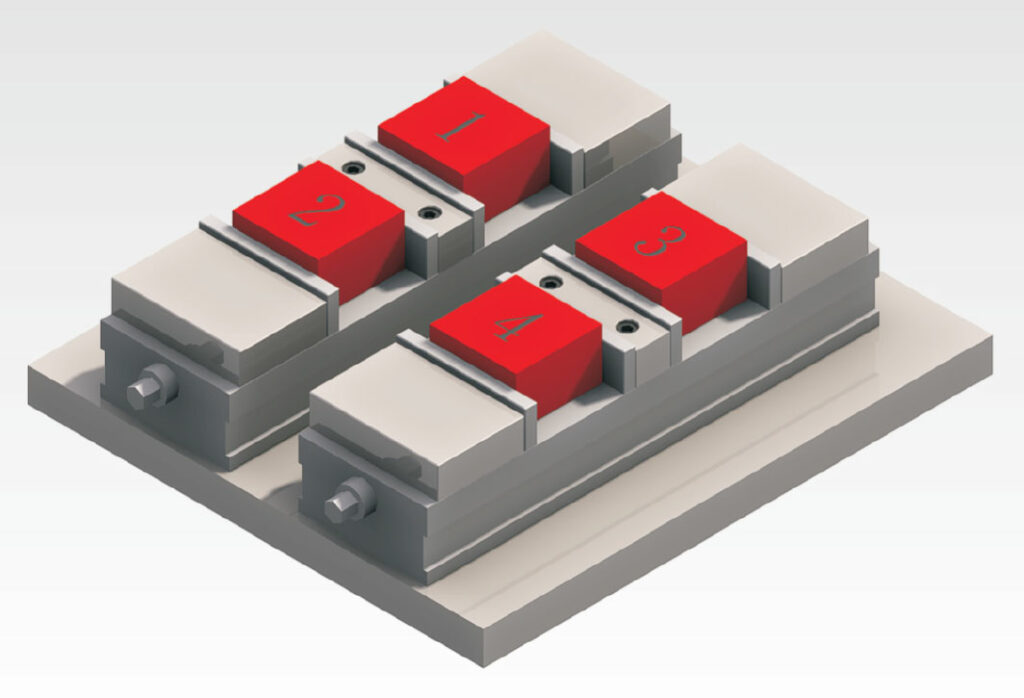
Standard vises also struggle with part families. If you’re running different part sizes or shapes across a production shift, you’re reconfiguring or swapping jaws between runs, more setup time, more opportunity for error.
What Is a Modular Vise?
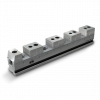
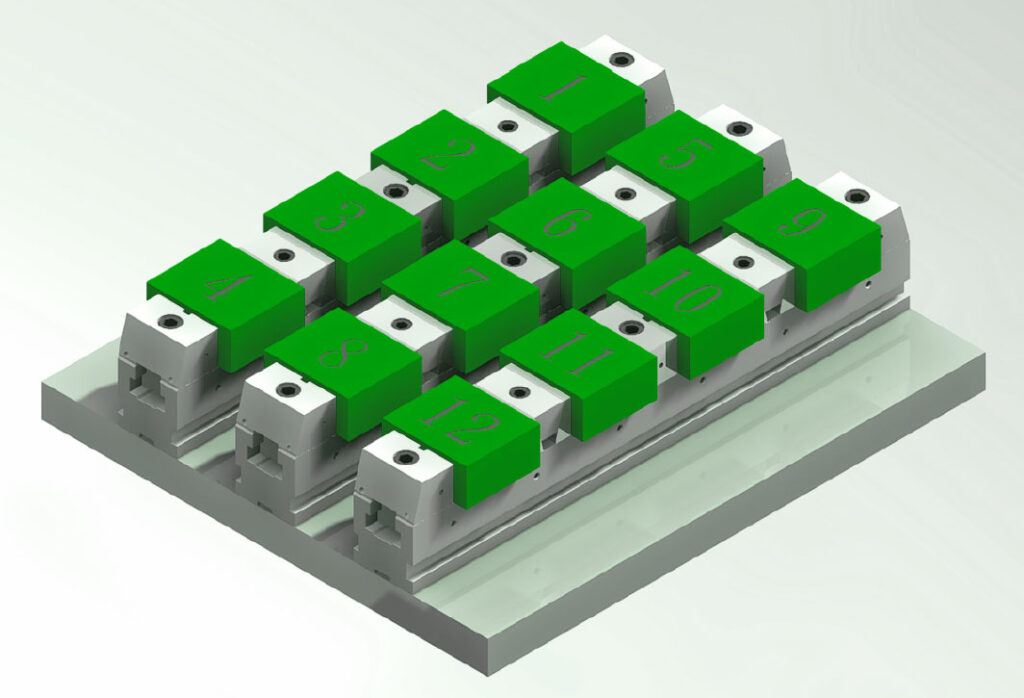
A modular vise is a configurable, multi-station clamping system built from interchangeable rail bodies and jaw components. Where a standard vise is a fixed unit, a modular system is a platform, you build the clamping configuration your parts need, and reconfigure it when the job changes.
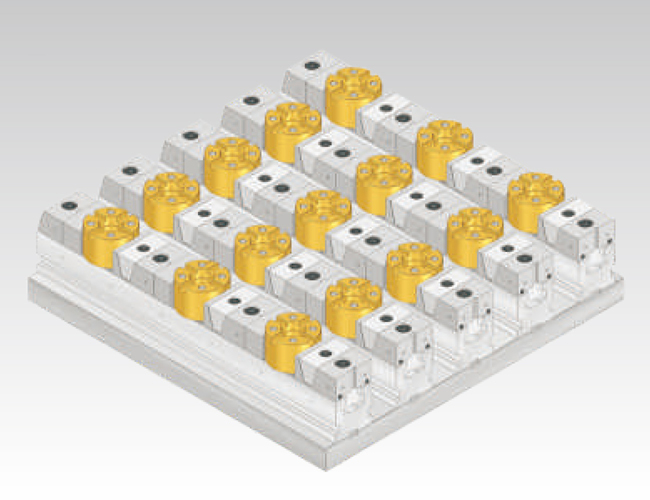
Tombstone City’s SVF Modular Vise System is built from 100% tool steel, hardened and ground, available in 12 sizes and three series:
- SVF Type A – single-sided, one-way clamping. Ideal for high-volume runs of prismatic parts where you need maximum station count in one direction.
- SVF Type BE – two-way clamping, high-density configuration. Clamps from both sides of the rail, maximizing the number of parts per station.
- SVF Type C – modular and disassembleable. Breaks into shorter segments for flexibility across different pallet sizes and configurations.
Clamping force reaches up to 6,600 lbs per station. The system accommodates a wide range of jaw types, smooth, serrated, stepped, V-jaw, and soft jaw, available through our accessories catalog so you can configure each station for the part geometry it’s holding.
Modular Vise vs. Standard Vise: Key Differences
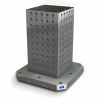
- Part capacity: A standard vise holds 1–2 parts per pallet load. The SVF system holds up to 13 parts per tombstone, that’s 6x or more parts per cycle without touching the machine.
- Clamping force: Standard vises vary widely by manufacturer and condition. SVF delivers a rated 6,600 lbs of clamping force, consistent across every station.
- Reconfigurability: Standard vises are single-purpose per setup. Modular vises adapt, change jaw types, station spacing, or rail orientation to match the next job without buying new fixturing.
- Machine compatibility: Standard vises work on any machine but don’t leverage HMC pallet indexing. Modular vises are designed to integrate with CNC tombstones and pallet systems to run all four faces per cycle.
- Footprint efficiency: Standard vises leave significant empty space on the pallet between setups. Modular systems are purpose-built to maximize part density within the available clamping envelope.
- Repeatability: Modular systems with hardened, ground components deliver guaranteed positional repeatability cycle to cycle. Standard vises depend on the condition of the leadscrew and jaw surfaces.
- Setup time: For short-run or one-off work, a standard vise is faster to put on the machine. Modular systems pay off on repeat production runs where the upfront configuration time amortizes across hundreds or thousands of parts.
When a Standard Vise Is the Right Call
Standard vises aren’t obsolete, they’re the right tool for specific situations. Choose a standard vise when:
- You’re running a prototype or one-off part that won’t repeat
- The part is too large or geometrically complex to run multiple stations on a single rail
- You’re on a VMC doing single-setup work where part density isn’t the constraint
- The job requires very high clamping force on an irregular surface that soft or custom jaws are better suited to handle
- Setup speed is more important than cycle efficiency because the run is short
When a Modular Vise Wins
Switch to a modular vise when production volume, spindle utilization, and cycle time are the priority. Choose modular when:
- You’re running repeat production jobs, the configuration gets built once and runs every cycle
- You’re on an HMC and want to maximize parts per pallet cycle across all indexed faces
- You’re targeting lights-out or unattended machining, more parts per load means longer unattended run times
- You’re running a family of similar parts and need a system that reconfigures between jobs without new fixtures
- You’re holding prismatic, round, or odd-shaped parts and need jaw flexibility, the SVF system’s interchangeable jaw library handles all of them
- You want to pair vises with angle plates or 5-axis vise fixtures for compound-angle or multi-face access in a single setup
The Productivity Gap: Running the Numbers
This is where the comparison becomes concrete. Consider a part that takes 4 minutes to machine:
Standard vise setup (2 parts per pallet): 2 parts × 4 min = 8 minutes of cutting per cycle. Add 2–3 minutes for load/unload and re-clamping and you’re looking at roughly 5–6 cycles per hour, 10–12 parts per hour per pallet.
SVF modular vise setup (13 parts per tombstone, 4 faces on an HMC): 52 parts per full pallet cycle. That same 4-minute cycle time per part runs for over 3 hours unattended before an operator needs to touch the machine.
The math is straightforward: more parts per load means more spindle uptime, fewer operator interventions, and a lower cost per part. On a shop running two shifts, that difference compounds into thousands of additional parts per month from the same machine.
What About Setup Cost?
Modular vise systems require more upfront investment than a standard vise, and the initial configuration takes more time. That’s a real consideration. But the correct way to evaluate it is cost per part over the life of the program, not sticker price per unit.
For any production run longer than a few dozen parts, the efficiency gains of a modular system typically recover the investment quickly. And because the SVF system’s rails and jaw components are fully reconfigurable and reusable, you’re not buying new fixturing every time a job changes, you’re rearranging the same components into a new configuration.
Free 3D CAD files are available for every component in the SVF lineup via the Tombstone City CAD Library. Download the models, build the configuration in your CAM software, and verify fit and clearances before you order or commit to a layout.
Key Takeaways
Standard vises are reliable, fast to put on the machine, and the right choice for low-volume or one-off work. Modular vise systems are built for production, more parts per load, guaranteed repeatability, flexible jaw configurations, and full compatibility with HMC tombstone and pallet indexing workflows.
If you’re running repeat jobs on an HMC and still using standard vises, your machine is almost certainly underperforming its potential throughput. The switch to modular doesn’t require a new machine, it requires a better fixture on the same machine.
Browse our full SVF lineup, sizes, and specs in the Tombstone City e-catalog, or use our sub-plate and vise configuration resources to start planning your setup.
Ready to see what a modular setup looks like for your parts?
Use the Find Your Tombstone tool to size your pallet configuration, or reach out to our team directly, we’ll help you spec the right vise system, jaw configuration, and tombstone for your machine and your production goals.