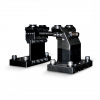
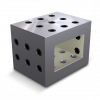
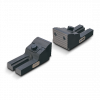





When you’re setting up workholding for an HMC or VMC, two products come up over and over again: tombstones and angle plates. At Tombstone City, we manufacture both, and we get asked which one is right almost every day. The honest answer is: it depends on your machine, your parts, and your production goals.
This guide breaks down the key differences between tombstones and angle plates, when each one makes sense, and how some shops use both together to get the most out of every pallet load.
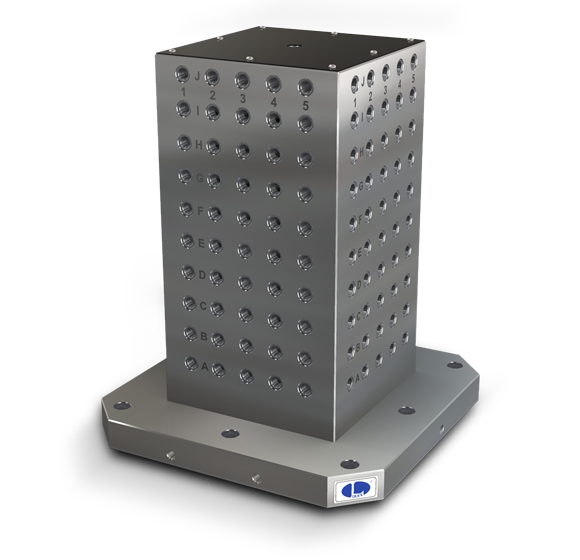
What Is a CNC Tombstone?
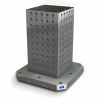
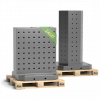
A CNC tombstone, also called a tooling column or fixture block, is a tall, vertical workholding fixture that mounts to the pallet of a Horizontal Machining Center (HMC). It stands upright and presents multiple flat working faces to the spindle as the pallet rotates through its B-axis indexing cycle.
The entire point of a tombstone is part density. Instead of loading one or two parts per pallet cycle, you load workpieces on every face of the tombstone before the cycle starts. The machine indexes through each face automatically, more parts per cycle, fewer machine stops, and a direct path toward lights-out production.
What Is a Workholding Angle Plate?
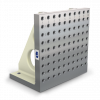
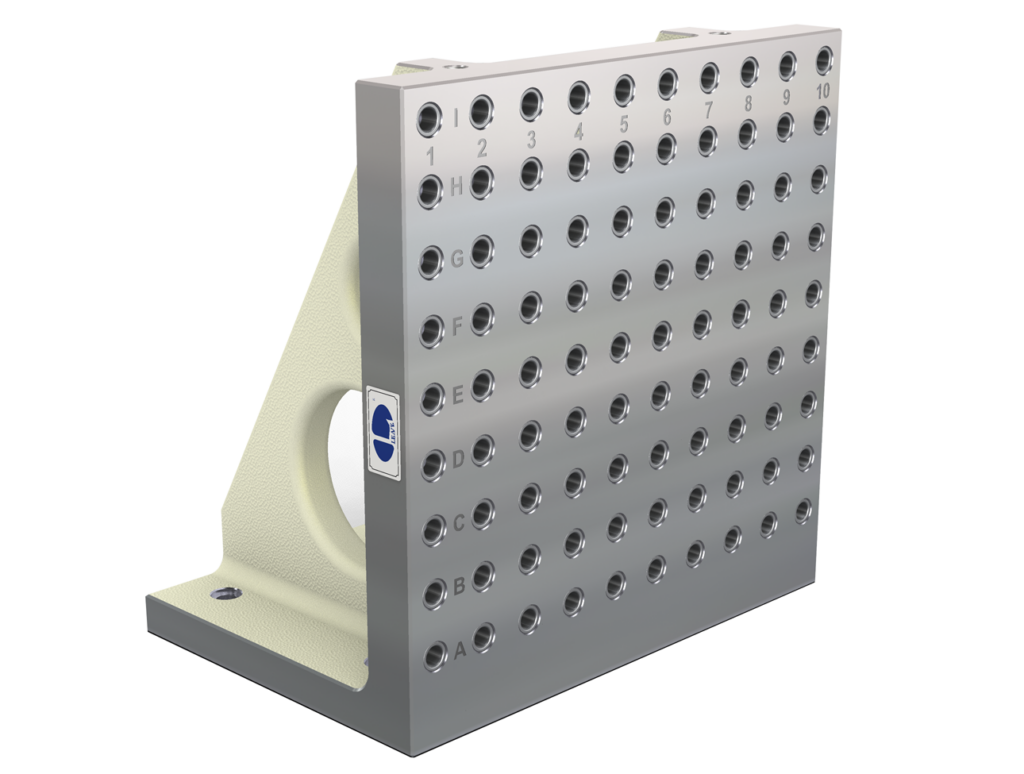
An angle plate is an L-shaped precision fixture that mounts to a machine table or pallet and presents a perpendicular clamping surface to the spindle. Where a tombstone gives you multiple faces through rotation, an angle plate gives you a second clamping reference, typically at 90 degrees, without needing a full pallet indexer.
Angle plates are used on both HMCs and VMCs. They’re especially valuable when you need to access two sides of a workpiece in a single setup, when your part is too large or too irregularly shaped for a standard tombstone face, or when you want to add vertical clamping capacity to an existing pallet setup without committing to a full tombstone configuration.
Tombstone vs. Angle Plate: Key Differences
Both fixtures are manufactured from the same FC300 gray cast iron and hold to the same precision ground tolerances, but they solve different problems. Here’s how they compare:
- Orientation: A tombstone stands fully vertical on the pallet and indexes through multiple faces. An angle plate is an L-shaped bracket that adds a vertical clamping face to a horizontal setup.
- Part capacity: Tombstones are built for maximum part density, multiple faces, multiple parts, one pallet load. Angle plates typically hold one or two workpieces per face at a time.
- Machine requirement: Tombstones get their full value on HMCs with B-axis pallet indexing. Angle plates work on any machine, HMC, VMC, or manual, wherever you need a perpendicular clamping surface.
- Setup flexibility: Angle plates are faster to configure for one-off or short-run jobs. Tombstones deliver maximum payoff on longer, repeat production runs.
- Footprint: Angle plates are compact and can be mounted alongside other fixtures on the same pallet. Tombstones are larger and typically occupy the full pallet.
When to Choose a Tombstone
A tombstone is the right call when throughput and spindle utilization are the priority. Choose a tombstone when:
- You’re running an HMC with a pallet indexer and want to maximize parts per cycle
- Your production runs are long enough to justify loading multiple parts per setup
- You’re targeting lights-out or unattended machining and need the machine to run as long as possible between operator interventions
- You’re running similar families of parts that benefit from consistent B-axis indexing across the pallet cycle
- You want to pair a tombstone with modular vises for fast, repeatable changeovers between production runs
When to Choose an Angle Plate
An angle plate makes more sense when you need access to multiple faces of a workpiece without full pallet rotation, or when you’re on a VMC where a tombstone isn’t an option. Choose an angle plate when:
- You’re machining on a VMC and need to access the side of a workpiece that would otherwise require a second setup
- Your part is large, asymmetrical, or awkward to fixture on a standard tombstone face
- You need a compact, low-profile workholding solution that fits alongside other fixtures on the same pallet
- You’re running prototype or short-run jobs where setup speed matters more than maximum part density
- You want to add vertical clamping capacity to an HMC pallet without a full tombstone configuration
Can You Use Both?
Yes, and plenty of shops do. Tombstones and angle plates aren’t competing solutions, they’re complementary ones. A common setup is mounting angle plates directly to the faces of a tombstone, giving you additional angular clamping surfaces on each indexed face. This is particularly useful for parts that need access at compound angles or where a perpendicular secondary reference improves datum control.
At Tombstone City, all of our tombstones and angle plates are manufactured from FC300 gray cast iron, fully finish-machined with ground mounting surfaces, and available with matching T-slot or grid hole patterns so they integrate cleanly with each other and with our modular vise systems. Free 3D CAD files and 2D PDFs are available for every product in our CAD Library; download both models and simulate the combined setup before you order.
If you’re not sure which configuration is right for your machine and your parts, our team can help. We’ve spec’d tombstones, angle plates, and combined setups for every major HMC and VMC platform on the market. Reach out directly or use our Find Your Tombstone tool to get started.
Not sure which is right for your setup?
Contact us today and let’s get the ball rolling.