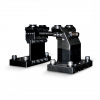
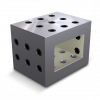
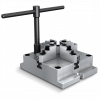
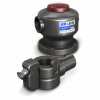
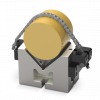

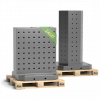


At Tombstone City, we talk to machine shop owners and CNC machinists every day who are leaving spindle time on the table, not because their machines are slow, but because their workholding isn’t working hard enough. If you’re running a Horizontal Machining Center (HMC) and still loading parts one or two at a time, a CNC tombstone might be the single most impactful upgrade you can make to your shop’s throughput.
In this guide, we’ll break down exactly what a CNC tombstone is, the types available, the real-world benefits for your shop, which material is right for your application, and how to choose the right tombstone for your specific machine.
What Exactly Is a CNC Tombstone?
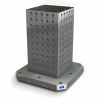
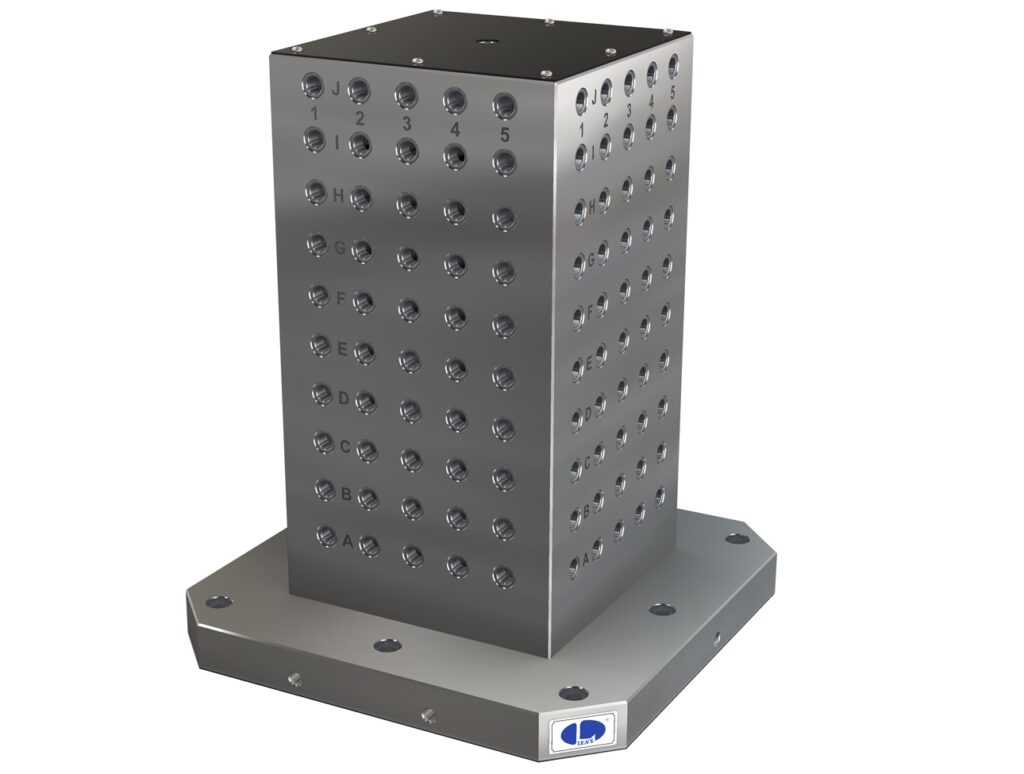
A CNC tombstone, also called a tooling column or fixture block, is a rigid, precision-machined vertical fixture that mounts to the pallet of a Horizontal Machining Center (HMC). It stands upright on the pallet and presents multiple flat working faces to the spindle as the pallet rotates through its B-axis indexing cycle.
Instead of clamping one or two parts flat on a table and stopping the machine to reload after every cycle, you load workpieces on every face of the tombstone before the cycle starts. The pallet indexer then rotates the tombstone so each face comes to the spindle in sequence; the machine keeps cutting while you load the other pallet. The name comes from the shape: early machinists thought the tall rectangular uprights looked like cemetery headstones. It stuck.
Tombstones also work on VMCs with a 4th-axis rotary table or trunnion setup to multiply part capacity, but the biggest gains are on HMCs with pallet pool systems and automatic pallet changers (APCs), where tombstones enable continuous production with minimal operator intervention.
Key Types of CNC Tombstones
The right configuration depends on your machine, your parts, and how many B-axis index positions your HMC controller supports. Here are the most common types:
- 4-Sided Square Column: The workhorse of the HMC world. Four machinable faces at 90-degree intervals, compatible with every standard HMC controller. Available in T-slot, grid pattern, and combination face configurations. If you’re new to tombstones, this is where to start.
- T-Block / Window Column: Features an open center cavity that reduces weight without sacrificing rigidity and gives you more clearance for tall parts or large vises. A smart choice when pallet weight is a concern.
- Cross-Pattern Tombstone: Four faces at 90 degrees with a plus-sign cross-section that opens up the center for vise and workpiece clearance, ideal when workholding hardware needs to extend deeper toward the pallet.
- Hexagonal Tombstone: Six faces at 60-degree intervals for maximum parts-per-pallet on compatible HMC controllers. Confirm your machine supports 60-degree B-axis indexing before specifying.
- Custom Tombstones: When standard configurations don’t match your pallet interface or application, we build to your exact spec, any size, shape, material, or face pattern. Get a custom fixture quote.
Main Benefits for Your Shop
The case for tombstones comes down to spindle utilization rate, the percentage of time your spindle is actually cutting metal. Every minute the machine is stopped for loading is a minute you’re paying for the machine without producing revenue. Here’s what changes when tombstones are in the equation:
- More parts per pallet load. A four-sided tombstone with modular vises can hold 8, 12, even 20+ parts per cycle, a 4x to 10x increase over a single vise setup on the same pallet.
- Fewer machine stops per hundred parts. More parts per load means fewer stops, more spindle time, and a lower cost-per-piece that compounds across your production volume.
- Lights-out machining becomes achievable. Load the tombstone at the end of a shift, hit cycle start, and let the machine run unattended. This isn’t theoretical, it’s what our customers do every day.
- Maximum rigidity under cutting forces. A precision-ground cast iron tombstone mounted solidly to the pallet delivers exceptional stability during heavy interrupted cuts, improving surface finish, tolerances, and tool life.
- Seamless integration with pallet pool systems. Load pallets during off-shifts, cycle through them during production hours, and virtually eliminate setup time from your critical path.
Material Matters: Cast Iron vs. Aluminum vs. Steel
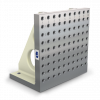
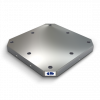
All of Tombstone City’s stock tombstones, angle plates, and sub-plates are manufactured from FC300 gray cast iron, equivalent to ASTM A48 Class 40. There’s a reason this has been the industry standard for precision workholding for decades. FC300 delivers superior vibration dampening compared to steel or aluminum, excellent dimensional stability at machining temperatures, and ships fully finish-machined with ground mounting surfaces; no additional prep required before you put it on the machine.
For extreme-duty applications like our BP40 V-Block series, we step up to FCD60 high-strength ductile iron for greater tensile strength under heavy clamping forces. Aluminum tombstones are available when your pallet’s weight rating is the limiting factor, roughly one-third the weight of cast iron, with the tradeoff of reduced dampening. Steel appears in specialized applications where specific strength or thermal properties are required, but for most production shops, FC300 cast iron outperforms it at lower cost.
Our recommendation is simple: start with FC300 cast iron. It’s what the best production shops in North America run, and it’s what we stock for same-day shipping.
How to Choose the Right Tombstone for Your Machining Center
Work through this checklist before you order; skipping any of these steps is how you end up with a fixture that doesn’t fit the pallet or a column that crashes into the spindle on the first cycle.
- Confirm your pallet size and mounting pattern. Pull the pallet spec sheet from your machine builder Haas, Mazak, Makino, Okuma, DMG MORI, Matsuura, and verify the T-slot or stud bolt spacing. The tombstone base must match exactly.
- Check your pallet’s weight capacity. Add tombstone weight + vises/clamps + maximum workpiece weight for a full load. If you’re close to the limit, a window column or aluminum tombstone gives you the headroom you need.
- Verify your B-axis index angles. 4-sided tombstones need 90-degree stops. 6-sided hex columns need 60-degree stops. 8-sided octagons need 45-degree stops. Confirm your controller supports the angles before you specify.
- Size the faces to your parts. Each working face must fit the part plus workholding hardware around it. Also confirm your longest tool clears the tombstone body at the lowest programmed Z position.
- Choose your face pattern. T-slots for flexible strap clamp setups, grid pattern for fast-changeover modular vise systems, or the T-slot + grid combination for maximum versatility, our most popular option.
- Download the CAD model first. Every tombstone in our catalog includes a free 3D CAD file and 2D PDF through our CAD Library. Load it into your CAM setup and verify clearances before you buy, it’s free, and it prevents the most expensive fitting errors.
Still not sure which tombstone fits your machine? Use our Find Your Tombstone selector or contact our team directly, we’ve spec’d tombstones for every major HMC platform on the market and we’ll point you in the right direction fast.
Ready to Put More Parts on Every Pallet?
If your shop runs an HMC and you’re still loading parts one at a time, you’re leaving production capacity on the floor every shift. A properly spec’d tombstone with the right workholding system immediately multiplies your parts-per-cycle, and it’s one of the fastest, most cost-effective paths toward lights-out manufacturing without adding a machine or an operator.
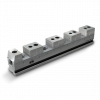
At Tombstone City, we stock hundreds of tombstones, angle plates, sub-plates, and modular vise systems in FC300 cast iron, fully finish-machined and ready to ship the same day your order lands before 11:00 am EST. Every product includes free 3D CAD files and 2D PDFs. And if nothing in our standard catalog fits your specific application, our custom fixture team will build exactly what you need.
Ready to start loading more parts per cycle?
Contact us today and let’s get the ball rolling.